The Impact of Certification Bodies on Trust in Remote Casino Operations

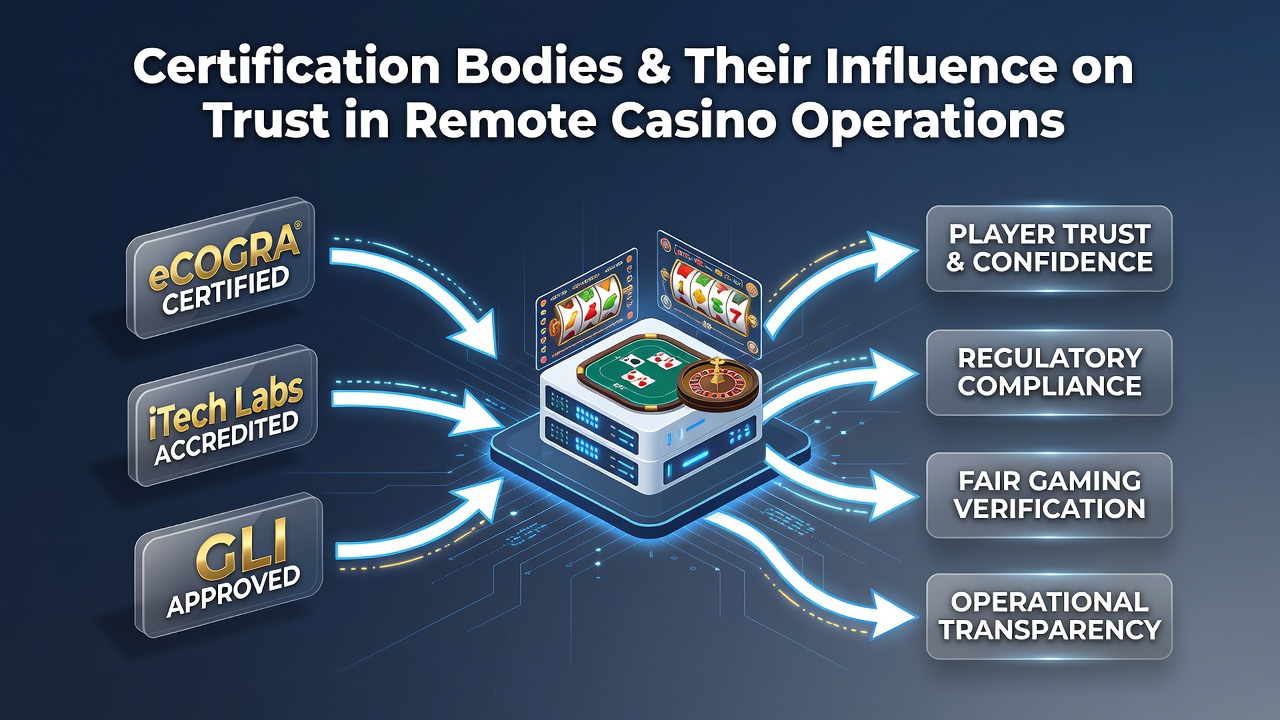
Certification bodies serve as independent evaluators that assess remote casino platforms against established technical and operational standards, and their assessments directly shape how players perceive reliability in online gambling environments. These organizations conduct audits on random number generators, payment processing systems, and data protection measures, which creates measurable benchmarks that operators must meet before receiving approval seals or compliance certificates.
Key Certification Bodies Operating Globally
Organizations such as Gaming Laboratories International and eCOGRA perform extensive testing on gaming software while authorities like the Malta Gaming Authority and iGaming Ontario enforce licensing requirements tied to those evaluations. Research from the European Gaming and Betting Association indicates that platforms holding multiple certifications experience higher retention rates because players recognize the verification processes involved in obtaining those credentials.
Each body maintains distinct protocols yet overlaps exist in areas like fairness testing and responsible gambling tool implementation, and observers note that operators often pursue certifications from several entities to broaden their market reach across different jurisdictions. Data compiled through 2025 shows a steady increase in certified platforms operating in regulated markets outside the UK, with particular growth in North American and European regions.
How Certifications Shape Player Confidence
Players encounter certification seals on casino websites and interpret these markers as evidence that games undergo regular fairness checks and that personal data receives protection through audited security frameworks. According to reports from regulatory bodies in Canada and Malta, certified operators demonstrate lower rates of dispute escalations because independent testing reduces the likelihood of software manipulation claims.
One study conducted by researchers at a European university tracked user behavior across certified versus non-certified sites and found that participants spent more time on platforms displaying active certification logos, which suggests that visible verification influences engagement patterns without requiring players to understand the underlying technical criteria. Certification renewal processes, typically conducted annually or semi-annually, further reinforce ongoing compliance because operators must address any identified deficiencies to retain their status.
Technical Standards and Audit Procedures
Certification involves rigorous examination of random number generator outputs to confirm statistical randomness, and bodies apply mathematical models to verify that game return-to-player percentages align with advertised figures. Payment system reviews focus on encryption strength and transaction logging accuracy, while additional checks cover bonus mechanics to prevent misleading promotional structures. Those who've examined audit reports note that detailed findings remain confidential between the operator and the certifying body, yet the issuance of a seal signals that core systems passed inspection.
By July 2026, several jurisdictions plan to introduce updated testing requirements for live dealer integrations and cryptocurrency transaction handling, which will expand the scope of certification work and require operators to adapt their infrastructure accordingly. Industry reports project that these updates will standardize practices across more markets and reduce discrepancies between regional standards.
Challenges in Maintaining Consistent Standards
Despite widespread adoption of certification frameworks, variations persist between bodies in testing frequency and criteria depth, and some operators strategically select less stringent certifiers to minimize operational costs. Regulatory agencies in different regions respond by requiring multiple certifications for market access, which creates layered verification that compensates for individual body differences. Evidence suggests that players benefit when operators maintain certifications from bodies recognized across multiple continents because cross-jurisdictional recognition adds another layer of scrutiny.
Future Developments in Certification Practices
Advancements in blockchain-based audit trails and real-time monitoring tools are beginning to influence how certification bodies conduct ongoing assessments, and these technologies allow for continuous rather than periodic verification of game outcomes and financial transactions. Organizations such as the European Gaming and Betting Association have documented pilot programs where automated reporting feeds directly into compliance dashboards, which reduces the manual workload during renewal cycles. Meanwhile, academic research continues to explore correlations between certification density and overall market stability in remote gambling sectors.
Conclusion
Certification bodies establish verifiable benchmarks that remote casino operators must satisfy, and their evaluations contribute measurable structure to player perceptions of platform integrity. As technical standards evolve through 2026 and beyond, the role of these organizations expands to cover emerging technologies while maintaining focus on fairness, security, and transparency across global markets. Multiple certifications from recognized entities continue to serve as practical indicators that platforms meet established operational criteria.